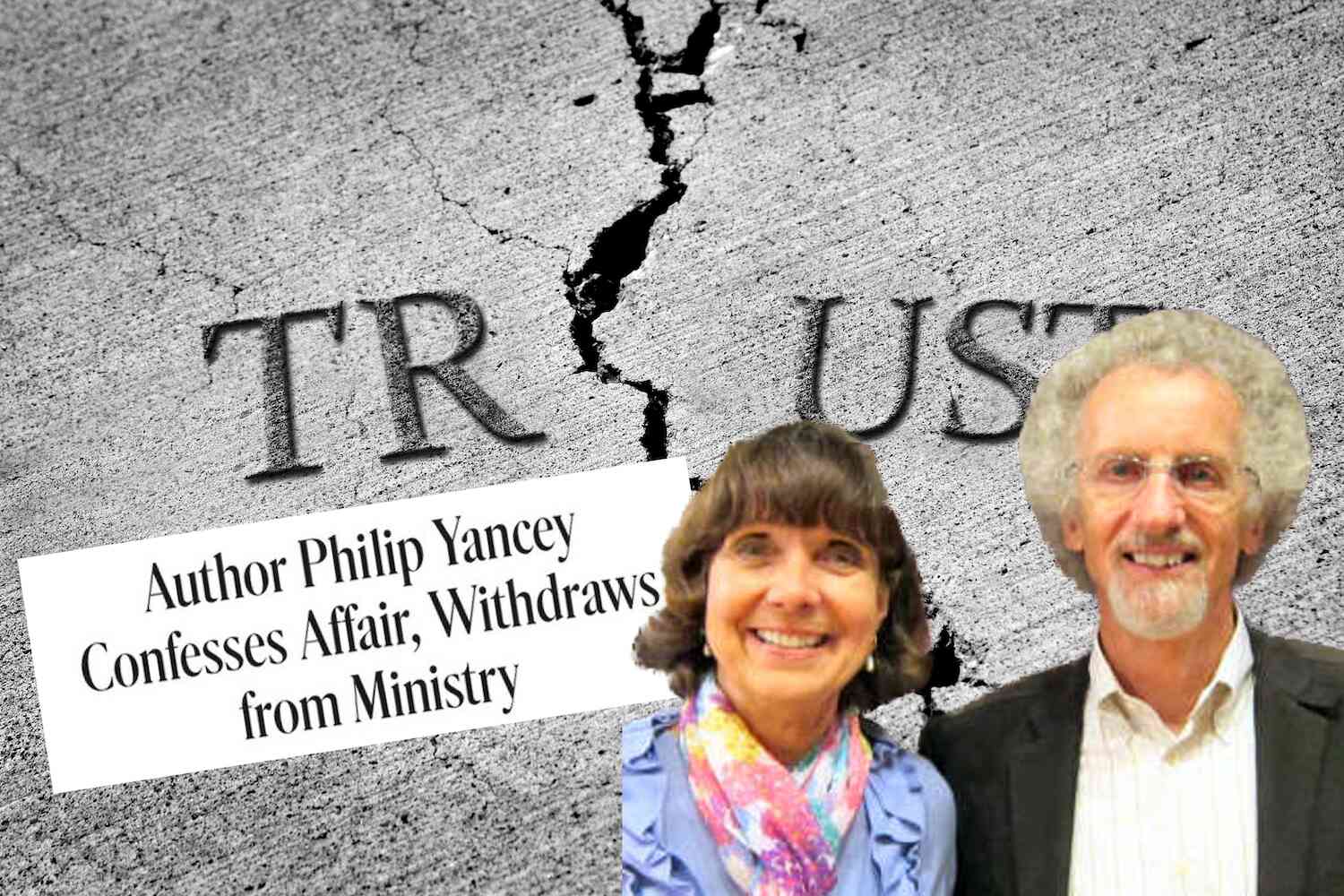

Recent news about the moral failure of prominent Christian author Philip Yancey has left many grieving, confused, and disillusioned.
It should.
Sin always leaves wreckage behind it. Despite all that it promises, what is left in its wake is nothing but a sorry array of victims, shame, loss, regret, and consequence.
But since we're all sinners, it's critical that we understand that if we stop at shock in these instances, or spend all our time gawking and pointing, we miss the opportunity to learn some soul-saving wisdom.
Moments like this invite us not merely to condemn or dissect another man and woman's failure, but to examine the deeper misunderstanding of love that so often sits beneath these depressing stories.
Because the truth is, most affairs do not begin with hatred for your spouse. They begin with a confusion about love that has been patiently planted and constantly reinforced by the world around us.
Real love, as Scripture describes it, is not built on infatuation, nor is it sustained by "chemistry." It does not survive by shared hobbies, physical attraction, or emotional excitement. Those things may accompany love in its early stages, but they are not love's foundation.
God teaches us that love is something forged over time - shaped by covenant, tested by suffering, refined by forgiveness, and strengthened by endurance.
The enemy tells a different story with the forked tongue of a self-obsessed culture.
It romanticizes beginnings, abandons middles, and doesn't give a thought to the end. It worships butterflies and despises perseverance. It treats boredom as a sign of death rather than a season of maturing.
We are conditioned to crave the escape:
Escape the marriage
Escape the ordinary
Escape the dull spouse
It's all done in pursuit of a more exciting self. What we foolishly believe is "falling out of love" is often nothing more than the realization that the other person is fully human. The mystery has worn off, and the covenant is beginning to take root.
That is precisely the moment when love is designed to deepen.
Instead, we are trained to believe that love belongs to the young and attractive. So when age changes us and life wears on us, when shared interests fade or routines harden, we assume love itself must be gone.
This is why middle-aged people suddenly feel "alive again" when someone new pays attention to them. A classmate, coworker, gym trainer, a friend who listens a little too closely. They confuse being seen again with being loved. They mistake emotional novelty for something much deeper.
Affairs rarely begin with deliberate evil. They begin with misdiagnosis:
"This must be love."
"This must mean my marriage is dead."
"This must be what I've been missing."
None of that is true of course; we're simply experiencing something fresh again and are mistaking the excitement of it all for love.
The tragedy then is not merely that we break our vows, but that we never learned what those vows were for in the first place. God did not design marriage to trap us. He designed it to:
Transform us.
Stretch us.
Mature us.
He designed it to teach us how to love another human being with patience, humility, sacrifice, and grace.
God's way is not only the righteous option, it is so much better for us. It protects us from the emotional chaos of chasing feelings that will never sustain us. It anchors us to something sturdier than chemistry.
When public failures occur, the proper response is neither smug judgment nor naive surprise. Rather we should humbly renew our fear of God that breeds a deeper gratitude for His commands and a clearer understanding that every boundary He sets is not meant to limit joy, but to preserve it.
Because in the end, God's way is not only holier. It is kinder, safer, and always better.
Our latest video 👇
Disclaimer: The opinions expressed in this article are those of the author and do not necessarily reflect the opinions of Not the Bee or any of its affiliates.