
My high-school yearbook is full of messages referencing my reputation as a feminist.
"When I first met you I thought you were cool, then I found out you were a feminist," one classmate wrote, jokingly.
Another wrote, "See you when you're the first female president!"
In my college dorm room hung a poster that read, "A woman needs a man like a fish needs a bicycle."
A few semesters later, I replaced it with one that read, "A woman's place is in the House and the Senate."
As I grew into marriage and motherhood, I retained many of those early feminist convictions. I studied the women who fought for my rights. Elizabeth Cady Stanton. Susan B. Anthony. Ida B. Wells. I celebrated the sacrifices of the generations before me who made it possible for me to vote, sign a mortgage, have a credit card, enjoy legal protections, pursue employment, and seek recourse against discrimination or harassment. These women fought so I could stand as an equal under the law.
But somewhere along the way, I realized that modern feminism was no longer about equality.
I saw slogans like "The Future Is Female."
I saw increasing hostility toward motherhood and traditional female roles.
I saw rising rates of anxiety and depression among women.
I came to the uncomfortable conclusion that whatever modern feminism had become, it was no longer helping women thrive.
During my most devoted feminist years, I was taught about THE PATRIARCHY. I learned that nearly every struggle I faced could be traced back to THE PATRIARCHY. Lack confidence? THE PATRIARCHY told you to be agreeable. Unhappy as a mother? THE PATRIARCHY imposed unrealistic expectations. Someone once told you to smile? THE PATRIARCHY again! Feeling overwhelmed by life? The dastardly PATRIARCHY strikes once more.
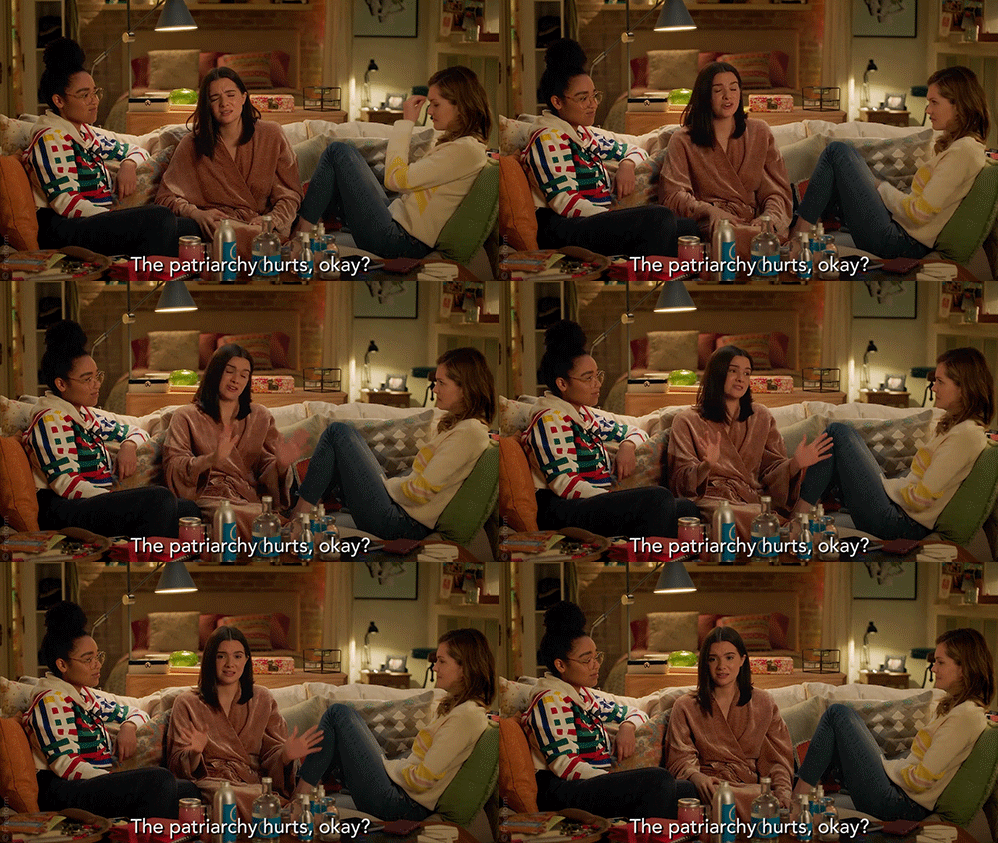
But no one can clearly explain what the patriarchy actually is anymore.
I understand what it meant a century ago. I understand what it looked like 50 years ago. But today, I'm still waiting for someone to identify who exactly is responsible for all this woe levied at women.
Who are these people? Can you name them? Can you articulate their goals and how they exert control over modern women's lives? The concept has become so abstract that it cannot be confronted, challenged, or defeated.
I had a wake-up-call moment about 10 years ago while talking with a friend who was in the process of leaving her husband. She told me she had read something on Instagram that changed her life. The message said, "Leave behind anything in your life that makes you unhappy."
I remember sitting with that idea for a long time.
Not because it was insightful, but because of how profoundly stupid it is.
Being an adult is hard. Marriage is hard. Motherhood is very hard. Growth does not come from avoiding difficulty. It comes from working through it. Leaving every situation that feels uncomfortable guarantees one thing only: you will never grow.
As I paid closer attention to feminist content online, I noticed how saturated it had become with shallow, self-destructive platitudes. At first glance, they sound empowering. But once you pause to think critically, the logic falls apart. Happiness is not a reliable compass. Truth is not something each person invents for themselves.
A major driver of this shift has been the rise of online, influencer-driven feminism. This version of feminism is shaped less by thinkers, organizers, or policy goals and more by algorithms, engagement metrics, and personal branding. It lives almost entirely on Instagram, TikTok, and Substack, where empowerment is reduced to shareable slogans, therapy-speak, and aesthetic outrage. In this world, feminism looks like affirmations about "protecting your peace," viral posts declaring that discomfort is trauma, and content creators reframing ordinary frustrations as systemic oppression.
Marriage becomes "emotional labor." Parenthood becomes "self-erasure." Accountability becomes "internalized misogyny." These messages are rarely paired with responsibility or context, but they are endlessly reinforced through likes and reposts. Influencer feminism does not ask women to build anything, sustain anything, or endure anything. It asks them only to feel validated (and preferably to keep scrolling).
Despite all this "empowerment," according to a 2023 Gallup poll, American women are twice as likely as men to be diagnosed with depression.
If modern attitudes toward womanhood are so liberating, why are women more anxious and depressed than ever?
I regularly see messaging on social media that borders on incoherent. A popular therapist recently posted, "Patriarchy taught women to shrink and call it something else." Half the women I know shared it.
(I still have no idea what it means.)
But the nonsensical messaging works. More than ever, women are detaching themselves from their relationships and responsibilities to find their "true authentic selves."
Personally, I have seen an increasing number of women leave their marriages, and sometimes even distance themselves from their children, in this pursuit. The language is always the same. But, to quote a line from a favorite Ben Fold's song, "Everywhere I go, damn there I am."
There are valid reasons to leave a relationship, but your husband asking you to please stop spending so much money at Target isn't abuse. Fleeting feelings of unhappiness, temporary despair, and the ordinary hardships of life are not oppression. They are part of being human.
I've been married for 18 years and have five children. There have been seasons when getting out of bed felt impossible. I've dealt with depression, anxiety, anger, marital strain, parenting challenges, and deep feelings of inadequacy. None of that is unusual. At some point, I made the decision to endure. And every time I did, the good eventually came. Sometimes quickly. Sometimes slowly. But it came.
Women do not grow by fleeing hard things.
Modern feminism invents an enemy that cannot be defined. Is your husband THE PATRIARCHY? Your father? Your sons? What does framing the world this way actually improve?
But more dangerously, modern feminism teaches women to outsource responsibility. If you are unhappy, it is someone else's fault. Your husband. Your children. Religion. Society. Your boss. The economy. The PATRIARCHY.
Online influencer feminism then convinces women to abandon what is good in pursuit of an imagined perfection just beyond reach.
But nothing worth having comes easily.
So reject the blame game. Fix what you can. Take responsibility for your own life. Your husband is not your enemy. Your children are not obstacles. Your life is far better than you have been told.
There has never been a better time in history to be a woman.
Robynn Garfield is first a wife and mom of five. She's worked as a journalist for 20 years covering primarily tech and pop culture, and is currently writing much less serious stuff at The Babylon Bee.
P.S. Now check out our latest video 👇
Disclaimer: The opinions expressed in this article are those of the author and do not necessarily reflect the opinions of Not the Bee or any of its affiliates.